

Unveiling the Mysteries of the Clitoris: A Whimsical Journey Through Time
Come one, come all, gather round as we embark on a whimsical journey through the annals of clitoral exploration!
Ancient Times
Way back in antiquity, the clitoris is very present in Greek and Latin medical literature. Soranos of Ephesus, author of Gynaikeia, a book about women’s health from the 2nd century AD, sets out a description of women’s sex organs.
He calls the clitoris ‘numphé’, or nymph – a word that denotes either an unmarried girl or a married young woman. This isn’t out of decorousness however: it relates the clitoris, which would normally be hidden by surrounding flesh, to the young female face. “If one calls this part the nymph”, the writer explains, “it’s because it hides under the lips, like young girls hide under their veil”.
The Greek word ‘kleitoris’ is used by Rufus of Ephesus, a contemporary of Soranos, author of anatomy book The Name of Body Parts. Without doubt linked to the verb ‘kleio’ (‘I shut’) the term also conjures the idea of an invisible organ, held prisoner within a confined space.
If the ‘nymph’ isn’t sufficiently demure but more or less protrudes, Soranos considers, that’s an anomaly needing surgical correction. The doctor advises slicing it off with a scalpel, taking care of avoiding too heavy a bleed.
This operation was performed at that time in Egypt, as the geographer Strabo describes. The author doesn’t name the clitoris but speaks of a form of female circumcision, conveyed by the Greek verb ‘ektemnein’ (‘removing by cutting’).
The Renaissance Revival
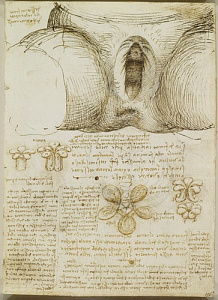
During the Renaissance, which spanned from the 14th to the 17th century, there was a resurgence of interest in human anatomy and physiology. Pioneering anatomists like Leonardo da Vinci embarked on groundbreaking studies, dissecting cadavers to unravel the mysteries of the human body. However, in the drawings of the vagina by Leonardo da Vinci, there is not a hint of a clitoris.
In 1559, the Italian physician Realdo Colombo published "De re anatomica", a comprehensive anatomical treatise that included detailed descriptions of the clitoris. Colombo's work provided valuable insights into the anatomy of this complex organ, shedding light on its role in female sexual pleasure.
Despite these advancements, the clitoris remained a subject of controversy and taboo. In many medical texts and anatomical drawings of the time, the clitoris was either omitted entirely or misrepresented in its anatomy. This discrepancy between scientific knowledge and societal perceptions perpetuated myths and misconceptions about female sexuality, contributing to the marginalization of the clitoris in mainstream discourse.
Modern Studies
Alfred Kinsey, a pioneering American biologist and sexologist, embarked on groundbreaking research in the mid-20th century to demystify human sexuality. Through his observations of female masturbation and interviews with thousands of women, Kinsey found that most of the women he observed and surveyed could not have vaginal orgasms, a finding that was also supported by his knowledge of sex organ anatomy. He "criticized Freud and other theorists for projecting male constructs of sexuality onto women" and "viewed the clitoris as the main center of sexual response". He considered the vagina to be "relatively unimportant" for sexual satisfaction, relaying that "few women inserted fingers or objects into their vaginas when they masturbated". Believing that vaginal orgasms are "a physiological impossibility" because the vagina has insufficient nerve endings for sexual pleasure or climax, he "concluded that satisfaction from penile penetration [is] mainly psychological or perhaps the result of referred sensation".
Later Masters and Johnson revealed that the structures of the clitoris not only encompass but also extend along and within the labia. These observations let them to the groundbreaking conclusion that both clitoral and vaginal orgasms share identical stages of physical response. Interestingly, their studies indicated that the vast majority of their subjects could only achieve orgasm through clitoral stimulation, with a minority experiencing vaginal orgasms. Building on this data, they visited that clitoral stimulation serves as the foundation for both types of orgasms. Their reasoning stemmed from the notion that during penetration, friction against the clitoral hood stimulates the clitoris, thereby contributing to the overall sexual experience.
The MRI Breakthrough
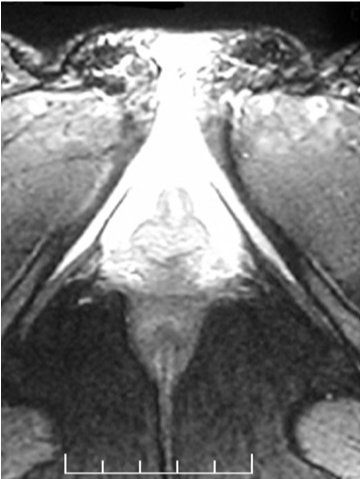
Now, let's zoom ahead to the early 21st century, where technology reigns supreme. In 2005, Dr. O'Connell and her colleagues conducted the first MRI study of the clitoris, which was published in The Journal of Urology. Using MRI technology, they were able to visualize the internal structure of the clitoris in living subjects, providing detailed images of the clitoral body, crura, and surrounding tissues. This research provided valuable insights into the size and shape of the clitoris, confirming its complex and multifaceted nature.

This study helped to challenge prevailing misconceptions about female sexual anatomy and contributed to a more accurate understanding of the clitoral complex. The findings from her research have had far-reaching implications for clinical practice, sexual health education, and the treatment of sexual dysfunction in women.
The 3D Modeling Marvel
In 2009, French researchers Odile Buisson and Pierre Foldès crafted the first 3D model of the clitoris, unlocking its intricate mysteries and shedding light on its wondrous complexity.

On the basis of their findings, they argued that women may be able to achieve vaginal orgasm via stimulation of the G-spot, because the highly innervated clitoris is pulled closely to the anterior wall of the vagina when the woman is sexually aroused and during vaginal penetration. They assert that since the front wall of the vagina is inextricably linked with the internal parts of the clitoris, stimulating the vagina without activating the clitoris may be next to impossible. In their 2009 published study, the "coronal planes during perineal contraction and finger penetration demonstrated a close relationship between the root of the clitoris and the anterior vaginal wall". Buisson and Folds suggested "that the special sensitivity of the lower anterior vaginal wall could be explained by pressure and movement of clitoris's root during a vaginal penetration and subsequent perineal contraction"
Accurate anatomical information about female pelvic structures should be found in classics, such as Gray’s Anatomy, the Hinman urological atlas, sexuality texts such as the classic Master and Johnson Human Sexual Response or any standard gynecologic text. These texts should provide the surgeon with information about how to preserve the innervation and vasculature to the clitoris and related structures but detailed information is lacking in each of these sources.
Anatomy of clitoris
Picture the shape of an upside-down "V" nestled within your pelvic cavity. This is the clitoris, a complex organ of sexual pleasure. What you can see and feel externally is just the tip of the iceberg – the glans, a small bump covered by a hood, peering above your urethral opening. However, beneath the surface lies the bulk of its structure.
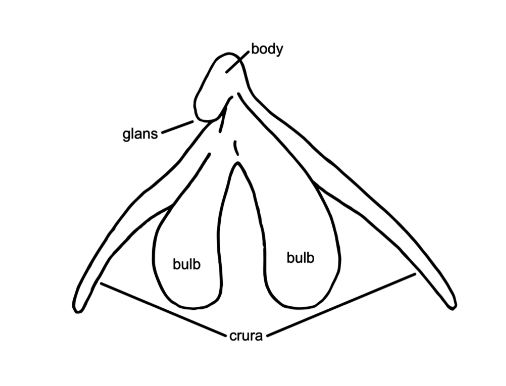
Each component plays a crucial role in sexual pleasure. When aroused, they engorge with blood. Notably, the glans, the most sensitive region, holds the key to female orgasmic bliss.
What do clitoris and penis have in common?
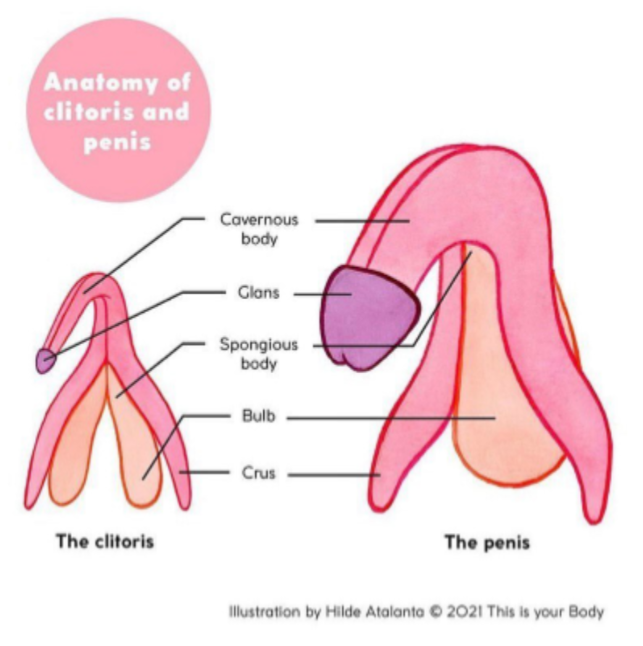
The clitoris and the penis have a lot in common and it’s not surprising. They are similar in structure, have the same position and they have identical anatomy and shape. They look related because they developed from the same structure in the embryo - “ambisexual genital tubercle”. And they are completely the same until the 6th week of pregnancy.
The presence of one chromosome affects the generation of the reproductive tissue. The presence of androgens activates the development of male reproductive system. In turn, the absence of androgens causes the ambisexual genital tubercle to become a clitoris. In addition, the male scrotum and female labia majora come from the same embryonic structure called the labioscrotal fold.
Since the clitoris and the penis have so much in common, then let's treat these two organs equally.
How many nerve endings does the clitoris have?
Clitoris is known to be the most highly sensitive organ among people with vulva. This happens due to the dorsal nerve of the clitoris -the branch of the pudendal nerve that terminates here as a network of highly sensitive nerve endings making it one of the densely innervated zones of the body. Dorsal nerve is 2 mm in diameter and it’s responsible for sexual pleasure as well as it takes part in clitoral erections.
According to the latest research, published in October 2022 by New Oregon Health & Science University-led, the human clitoris has over 10,000 nerve endings. It’s about 20% more than 8,000 - the data that were widely known earlier. And it’s incredible that so many nerve endings are located in such a small area. So clitoris has more nerve endings than any other part of the vulva.
There's no denying the sensual side of nerves. These nerves can produce a lot of delightful sensations, depending on how the clitoris is stimulated and how intense the arousal is. Therefore, there is no reason to underestimate the clitoris both in terms of pleasure and medicine. Lack of information about clitoral innervation can lead to serious consequences, for example during such surgeries as vulvoplasty or labiaplasty.
Clitoral erection
During sexual arousal, the clitoris and the entire female genitalia fills with blood. This happens due to the fact that the muscles contract and squeeze clitoral veins. At the same time, arterial blood flow is carrying on. Then blood fills the venous spaces in the corpora cavernosa of the clitoris, increasing its size. As far as the clitoris is highly innervated, stimulation of it may lead to female orgasm.
So, this is almost the same process as with penile erection. And this gives us the right to assert that a woman in sex is not a passive receiving party. People with vulvas, like people with penises, also have erections. And it is a very important stage on the way to orgasm, which should not be ignored.
What do the clitoris and penis go through during an orgasm?
The next stage is called plateau. The phase is characterized by increased blood circulation and heart rate, as well as increased sexual pleasure.
Third phase is the orgasm phase that is associated with uterine and vaginal contractions among women and ejaculation among men.
The last phase is also called the refractory phase and during this recovery period, muscles relax and blood pressure drops. An interesting fact is that men at this moment cannot have sex and have an orgasm, while women can.
Since we know that the clitoris is responsible for orgasm in a woman's body, it remains unclear why there is still a belief in society that women should have an orgasm without clitoral stimulation, but only from penetration?
But can we imagine that millions of men will try to have sex WITHOUT stimulation of the glans of the penis and without direct stimulation of the shaft of the penis?
Only "accidental" touches and nothing more? Definitely not.
Our body is capable of giving us great pleasure. Thanks to science and instincts now we know how to find a way to do it.
Come one, come all, gather round as we embark on a whimsical journey through the annals of clitoral exploration!
Ancient Times
Way back in antiquity, the clitoris is very present in Greek and Latin medical literature. Soranos of Ephesus, author of Gynaikeia, a book about women’s health from the 2nd century AD, sets out a description of women’s sex organs.
He calls the clitoris ‘numphé’, or nymph – a word that denotes either an unmarried girl or a married young woman. This isn’t out of decorousness however: it relates the clitoris, which would normally be hidden by surrounding flesh, to the young female face. “If one calls this part the nymph”, the writer explains, “it’s because it hides under the lips, like young girls hide under their veil”.
The Greek word ‘kleitoris’ is used by Rufus of Ephesus, a contemporary of Soranos, author of anatomy book The Name of Body Parts. Without doubt linked to the verb ‘kleio’ (‘I shut’) the term also conjures the idea of an invisible organ, held prisoner within a confined space.
If the ‘nymph’ isn’t sufficiently demure but more or less protrudes, Soranos considers, that’s an anomaly needing surgical correction. The doctor advises slicing it off with a scalpel, taking care of avoiding too heavy a bleed.
This operation was performed at that time in Egypt, as the geographer Strabo describes. The author doesn’t name the clitoris but speaks of a form of female circumcision, conveyed by the Greek verb ‘ektemnein’ (‘removing by cutting’).
The Renaissance Revival
During the Renaissance, which spanned from the 14th to the 17th century, there was a resurgence of interest in human anatomy and physiology. Pioneering anatomists like Leonardo da Vinci embarked on groundbreaking studies, dissecting cadavers to unravel the mysteries of the human body. However, in the drawings of the vagina by Leonardo da Vinci, there is not a hint of a clitoris.
In 1559, the Italian physician Realdo Colombo published "De re anatomica", a comprehensive anatomical treatise that included detailed descriptions of the clitoris. Colombo's work provided valuable insights into the anatomy of this complex organ, shedding light on its role in female sexual pleasure.
Despite these advancements, the clitoris remained a subject of controversy and taboo. In many medical texts and anatomical drawings of the time, the clitoris was either omitted entirely or misrepresented in its anatomy. This discrepancy between scientific knowledge and societal perceptions perpetuated myths and misconceptions about female sexuality, contributing to the marginalization of the clitoris in mainstream discourse.
Modern Studies
Alfred Kinsey, a pioneering American biologist and sexologist, embarked on groundbreaking research in the mid-20th century to demystify human sexuality. Through his observations of female masturbation and interviews with thousands of women, Kinsey found that most of the women he observed and surveyed could not have vaginal orgasms, a finding that was also supported by his knowledge of sex organ anatomy. He "criticized Freud and other theorists for projecting male constructs of sexuality onto women" and "viewed the clitoris as the main center of sexual response". He considered the vagina to be "relatively unimportant" for sexual satisfaction, relaying that "few women inserted fingers or objects into their vaginas when they masturbated". Believing that vaginal orgasms are "a physiological impossibility" because the vagina has insufficient nerve endings for sexual pleasure or climax, he "concluded that satisfaction from penile penetration [is] mainly psychological or perhaps the result of referred sensation".
Later Masters and Johnson revealed that the structures of the clitoris not only encompass but also extend along and within the labia. These observations let them to the groundbreaking conclusion that both clitoral and vaginal orgasms share identical stages of physical response. Interestingly, their studies indicated that the vast majority of their subjects could only achieve orgasm through clitoral stimulation, with a minority experiencing vaginal orgasms. Building on this data, they visited that clitoral stimulation serves as the foundation for both types of orgasms. Their reasoning stemmed from the notion that during penetration, friction against the clitoral hood stimulates the clitoris, thereby contributing to the overall sexual experience.
The MRI Breakthrough
Now, let's zoom ahead to the early 21st century, where technology reigns supreme. In 2005, Dr. O'Connell and her colleagues conducted the first MRI study of the clitoris, which was published in The Journal of Urology. Using MRI technology, they were able to visualize the internal structure of the clitoris in living subjects, providing detailed images of the clitoral body, crura, and surrounding tissues. This research provided valuable insights into the size and shape of the clitoris, confirming its complex and multifaceted nature.
This study helped to challenge prevailing misconceptions about female sexual anatomy and contributed to a more accurate understanding of the clitoral complex. The findings from her research have had far-reaching implications for clinical practice, sexual health education, and the treatment of sexual dysfunction in women.
The 3D Modeling Marvel
In 2009, French researchers Odile Buisson and Pierre Foldès crafted the first 3D model of the clitoris, unlocking its intricate mysteries and shedding light on its wondrous complexity.
On the basis of their findings, they argued that women may be able to achieve vaginal orgasm via stimulation of the G-spot, because the highly innervated clitoris is pulled closely to the anterior wall of the vagina when the woman is sexually aroused and during vaginal penetration. They assert that since the front wall of the vagina is inextricably linked with the internal parts of the clitoris, stimulating the vagina without activating the clitoris may be next to impossible. In their 2009 published study, the "coronal planes during perineal contraction and finger penetration demonstrated a close relationship between the root of the clitoris and the anterior vaginal wall". Buisson and Folds suggested "that the special sensitivity of the lower anterior vaginal wall could be explained by pressure and movement of clitoris's root during a vaginal penetration and subsequent perineal contraction"
Accurate anatomical information about female pelvic structures should be found in classics, such as Gray’s Anatomy, the Hinman urological atlas, sexuality texts such as the classic Master and Johnson Human Sexual Response or any standard gynecologic text. These texts should provide the surgeon with information about how to preserve the innervation and vasculature to the clitoris and related structures but detailed information is lacking in each of these sources.
Anatomy of clitoris
Picture the shape of an upside-down "V" nestled within your pelvic cavity. This is the clitoris, a complex organ of sexual pleasure. What you can see and feel externally is just the tip of the iceberg – the glans, a small bump covered by a hood, peering above your urethral opening. However, beneath the surface lies the bulk of its structure.
The clitoris comprises several interconnected parts:
- The clitoral body, anchoring to the pubic bone.
- The clitoral root, linking the body to the legs.
- The clitoral crura, extending from 5 to 9 centimeters beneath the labia majora.
- The bulbs of the vagina, nestled between the external urethral opening and the clitoris, spanning approximately 3 to 7 centimeters
Each component plays a crucial role in sexual pleasure. When aroused, they engorge with blood. Notably, the glans, the most sensitive region, holds the key to female orgasmic bliss.
What do clitoris and penis have in common?
The clitoris and the penis have a lot in common and it’s not surprising. They are similar in structure, have the same position and they have identical anatomy and shape. They look related because they developed from the same structure in the embryo - “ambisexual genital tubercle”. And they are completely the same until the 6th week of pregnancy.
The presence of one chromosome affects the generation of the reproductive tissue. The presence of androgens activates the development of male reproductive system. In turn, the absence of androgens causes the ambisexual genital tubercle to become a clitoris. In addition, the male scrotum and female labia majora come from the same embryonic structure called the labioscrotal fold.
What else:
- Both of them can become erect.
- Their sexual arousal process is identical.
- They go through the same orgasm stages.
And there are not so many differences:
- The male urethra is located directly at the glans of the penis. While in the female genital organs it is located separately - immediately under the glans of the clitoris.
- And the most obvious difference is that the penis is located outside, while the clitoris is hidden inside the body - from the outside we see only its head.
Since the clitoris and the penis have so much in common, then let's treat these two organs equally.
How many nerve endings does the clitoris have?
Clitoris is known to be the most highly sensitive organ among people with vulva. This happens due to the dorsal nerve of the clitoris -the branch of the pudendal nerve that terminates here as a network of highly sensitive nerve endings making it one of the densely innervated zones of the body. Dorsal nerve is 2 mm in diameter and it’s responsible for sexual pleasure as well as it takes part in clitoral erections.
According to the latest research, published in October 2022 by New Oregon Health & Science University-led, the human clitoris has over 10,000 nerve endings. It’s about 20% more than 8,000 - the data that were widely known earlier. And it’s incredible that so many nerve endings are located in such a small area. So clitoris has more nerve endings than any other part of the vulva.
There's no denying the sensual side of nerves. These nerves can produce a lot of delightful sensations, depending on how the clitoris is stimulated and how intense the arousal is. Therefore, there is no reason to underestimate the clitoris both in terms of pleasure and medicine. Lack of information about clitoral innervation can lead to serious consequences, for example during such surgeries as vulvoplasty or labiaplasty.
Clitoral erection
During sexual arousal, the clitoris and the entire female genitalia fills with blood. This happens due to the fact that the muscles contract and squeeze clitoral veins. At the same time, arterial blood flow is carrying on. Then blood fills the venous spaces in the corpora cavernosa of the clitoris, increasing its size. As far as the clitoris is highly innervated, stimulation of it may lead to female orgasm.
So, this is almost the same process as with penile erection. And this gives us the right to assert that a woman in sex is not a passive receiving party. People with vulvas, like people with penises, also have erections. And it is a very important stage on the way to orgasm, which should not be ignored.
What do the clitoris and penis go through during an orgasm?
Both the clitoris and the penis are connected to the pudendal nerve. The pudendal nerve is a sympathetic nerve, which means that it reacts to excitation. That is why both of them will have the same stages of orgasm, that are:
- excitement phase
- plateau phase
- orgasm phase
- resolution phase
In people with penises, this phase is characterized by an erection that can disappear and reappear repeatedly during the arousal stage.
in people with vulvas, the excitement phase is characterized by the fact that the clitoris and labia minora begin to swell, and the walls of the vagina begin to secrete liquid - natural lubricant.The next stage is called plateau. The phase is characterized by increased blood circulation and heart rate, as well as increased sexual pleasure.
Third phase is the orgasm phase that is associated with uterine and vaginal contractions among women and ejaculation among men.
The last phase is also called the refractory phase and during this recovery period, muscles relax and blood pressure drops. An interesting fact is that men at this moment cannot have sex and have an orgasm, while women can.
Since we know that the clitoris is responsible for orgasm in a woman's body, it remains unclear why there is still a belief in society that women should have an orgasm without clitoral stimulation, but only from penetration?
But can we imagine that millions of men will try to have sex WITHOUT stimulation of the glans of the penis and without direct stimulation of the shaft of the penis?
Only "accidental" touches and nothing more? Definitely not.
Our body is capable of giving us great pleasure. Thanks to science and instincts now we know how to find a way to do it.